
27 May 2026
The independent statutory body, the Workplace Relations Commission (WRC), has released its 2025 Annual Report, noting a decline in adjudication hearings and growth in mediation, inspection, and information services, complemented by impactful enforcement.
The 2025 Annual Report highlights a pivot in service delivery, with a 10% reduction in adjudication hearings, a 16% rise in mediation delivery, and an 8.5% increase in completed workplace inspections. Wage recovery fell by 26.8%. The WRC continued proactive minimum wage compliance campaigns and targeted actions on employment rights and permit compliance in the commercial sea fishing sector, alongside civil enforcement of adjudication awards and multi-agency inspections with An Garda Síochána, the Department of Social Protection, and the Revenue Commissioners.
The Workplace Relations Commission Report 2025 key results include:
€1,578,924 recovered in unpaid wages

4,289 Adjudication Hearings Held -10%

5,596 Workplace Inspections Completed

The WRC received 64,648 Infoline calls and 4.7m website views

85% Conciliation Success Rate

1,034 Mediations Delivered
+16%

The Inspection and Enforcement Division is the regulatory and enforcement arm of the WRC, which has responsibility for conducting workplace inspections of employment records to ensure employer compliance with employment law, prosecuting breaches, the enforcement of awards, and employment agency licensing. Part of the inspection process involves inspectors visiting places of employment (these visits may be either announced or unannounced). Inspectors are legally empowered to enter a workplace. It is a criminal offence for any person to obstruct or provide misleading information to an inspector.
The inspection process typically involves the following steps:
| Inspections | 2024 | 2025 | Difference (% increase) |
|---|---|---|---|
| Employers Inspected | 5,156 | 5,145 | -0.21% |
| Employers in breach of employment law obligations | 2,108 | 1,775 | -15.8% |
| Unpaid Wages Recovered (€) | 2,158,870 | 1,578,924 | -26.8% |
| Number of Specific Complaints Received | 1,217 | 1,637 | +34.5% |
| Total Number of Workplace Inspections | 6,217 | 5,596 | -9.9% |
The Inspection and Enforcement Services of the WRC use a compliance-based approach, prioritising bringing non-compliant employers into line with their legal obligations.
In 2025, 1,775 employers were identified as in breach of their obligations. However, the majority of employers co-operated with the WRC, achieving compliance, resulting in 223 employer prosecutions (an increase of 27.5% on prosecutions in 2024).
Of the 223 prosecutions that were taken in 2025, 183 resulted in successful outcomes (prosecution, probation or charitable donations). In addition, WRC inspectors issued 23 fixed payment notices and 50 compliance notices in 2025.
| Enforcement Outcomes | Number |
|---|---|
| Convicted | 78 |
| Probation Act | 7 |
| Charitable Donations | 24 |
| Probation & Charitable Donations | 70 |
| Withdrawn | 11 |
| Dismissed | 1 |
| Struck Out | 6 |
| Bench Warrant Issued | 4 |
| Decision not to Prosecute | 10 |
| Unable to Prosecute | 12 |
The WRC carries out a campaign aimed at highlighting the changes to the National Minimum Wage (NMW) in January of each year. The 2025 campaign focused on creating awareness of the NMW increase and carrying out inspections to ensure employers are compliant with the NMW rate increase.
The 2025 campaign inspections found 101 compliant employers, with a further 178 employers becoming compliant as a result of the campaign. Three employers were prosecuted and a total of €62,082 in unpaid wages was directed to employees, as a result of the campaign.
Throughout 2025, the Commercial Sea Fishing sector remained a priority for WRC inspections. 76 inspections were completed by the WRC inspectors throughout the year, leading to a total of 309 fishery inspections, between the years 2021 and the end of 2025. The aim of the campaign is to ensure both employment rights and employment permit compliance on commercial fishing vessels.
Most inspections were unannounced, followed by scheduled visits where additional records were required for review.
In 2025, the WRC’s Civil Enforcement Section handled 106 civil enforcement cases. In 19 cases, following intervention by WRC enforcement staff, employers paid the adjudication awards, prior to the application of a court order.
These enforcements resulted in a total of €166,974 worth of awards being recovered for employees.
The WRC Inspectorate has the power to share information, and conduct joint inspections, with other State bodies. In 2025, 290 inspections were carried out with An Garda Síochána (including the Garda National Immigration Bureau and the Garda National Protective Service). WRC Inspectors undertook 236 joint inspections with the Department of Social Protection, 311 with the Revenue Commissioners, and 3 with the Road Safety Authority (RSA).
The WRC inspected a large variety of employers in 2025.The top five inspected sectors based on case count were as follows:
| Sector | Cases | Number in Breach | Incidences of Breach % | Unpaid Wages |
|---|---|---|---|---|
| Food Service Activities | 1,591 | 659 | 41%% | €345,648 |
| Wholesale & Retail Trade | 1,281 | 374 | 29% | €235,854 |
| Hair & Beauty | 464 | 182 | 39% | €31,347 |
| Construction | 298 | 60 | 20% | €151,297 |
| Human Health & Social Work | 226 | 64 | 28% | €140,747 |
On examination of the convictions made during 2025, we can see that the sector with the highest levels of convictions relates to Food Service Activities. The sectors that saw the highest number of prosecutions include:
| Sector | Cases 2025 |
|---|---|
| Food Service Activities | 42 |
| Hair and Beauty | 11 |
| Wholesale & Retail Trade | 5 |
| Other Service Activities | 6 |
| Construction | 4 |
| Hotels | 2 |
The Knowledge, Information and Advisory (KIA) Division was created in 2025 as part of an internal restructuring. It combines Information and Customer Services and Advisory Services to strengthen the WRC’s focus on preventing workplace disputes.
The Division provides impartial information on employment law and the WRC’s functions, processes complaints and applications, and develops guidance, Codes of Practice and education programmes. It also promotes dispute prevention through training, outreach and stakeholder engagement, and is modernising services using digital tools such as an online learning platform and chatbot technology.
The WRC received 10,559 Complaint Applications, comprising of 19,068 individual complaints in 2025. This is an average of two individual complaints per complaint application, reflecting a 44% increase in Complaint Applications and an increase of 28% in individual complaints compared to 2024.
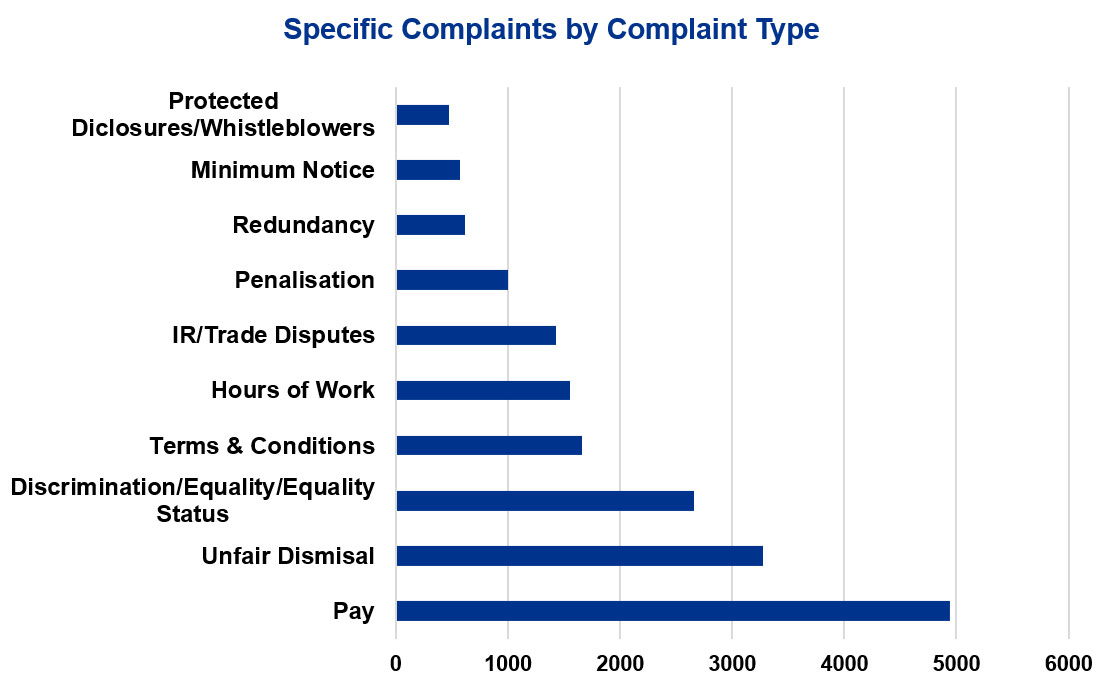
The report notes that the number of total Complaint Applications had risen significantly compared to 2024. 26% of the 19,068 individual complaints received related to pay issues. Unfair dismissal complaints comprised of 17% of the cases, with a further 14% of complaints relating to discrimination, equality and equal status complaints. 9% of cases related to working time and terms of employment complaints, while trade disputes represented 8% of all complaints received in 2025.
In the below infographic we have outlined the top 10 complaints by complaint type. The leading complaint is pay related issues, with a total of 4,939 pay related complaints throughout the year.
The WRC closed almost 18,981 specific complaints in 2025. 63% of these complaints were withdrawn before during or post adjudication hearing.
2,506 Decisions and Recommendations were issued by the Adjudication Services in 2025. The number of decisions issued in 2025 sees a slight decrease compared to that of 2024 (2,712) and a further decrease compared to 2023 (2,951). The Director of Adjudication Services noted that the decrease in the total number of adjudication decisions issued in 2025 is likely a direct correlation of the increase in the complexity of cases dealt with by the adjudication services in 2025.
The Adjudication service received 1,492 complaints under the Employment Equality Act, citing 1,995 grounds of discrimination. This was an increase of 30% on complaints received compared to 2024 figures. Disability was the most common ground that referrals were based on (31%), followed by gender (20%) and race (19%). Referrals made on the grounds of disability and gender saw the largest increases in percentage on complaints received compared to 2024 figures (53% and 49% respectively).
The report notes that the grounds of disability, race and gender continue to be the most cited grounds of discrimination, referred to the WRC for the year 2025.
| Breakdown of complaints by ground under the Employment Equality Acts | 2024 | 2025 | Difference (%) |
|---|---|---|---|
| Age | 218 | 189 | -13% |
| Civil Status | 72 | 54 | -25% |
| Disability | 410 | 622 | +52% |
| Family Status | 177 | 233 | +32% |
| Gender | 318 | 394 | +24% |
| Membership of the Traveller Community | 23 | 17 | -26% |
| Race | 302 | 372 | +23% |
| Religion | 48 | 63 | +31% |
| Sexual Orientation | 49 | 51 | +4% |
| Total | 1,617 | 1,995 | +23% |
2025 saw the receipt of 708 referrals to the WRC under the Equal Status Acts 2000. A total of 1,158 specific grounds were cited in these referrals. The total number of referrals received by the WRC increased by 15% since 2024, with an increase of 6% when considering the grounds of discrimination cited.
Referrals on the grounds of disability increased by 53% (293) on figures for 2024 (192), making a complaint on the ground of disability the most frequently cited ground of discrimination in 2025, under the Equal Status Acts 2000. The graph below provides a breakdown of the grounds under which complaints were referred.
| Equal Status Ground | 2024 | 2025 | % Change |
|---|---|---|---|
| Age | 56 | 64 | +14% |
| Civil Status | 42 | 54 | +29% |
| Disability | 192 | 293 | +53% |
| Family Status | 59 | 80 | +36% |
| Gender | 73 | 109 | +49% |
| Membership of the Traveller Community | 245 | 105 | -57% |
| Race | 215 | 236 | +10% |
| Religion | 58 | 60 | +3% |
| Sexual Orientation | 31 | 26 | +16% |
| Accommodation | 118 | 131 | +11% |
56 referrals were received under the Pensions Act 1990 in 2025; an increase of 30% on referrals received in 2024.
In 2025, the WRC was notified of 300 Labour Court Decisions/Recommendations arising from appeals of WRC Decisions/Recommendations. Of these, 68% (205) were upheld, 17% (50) were varied, and 15% (45) were overturned.
The WRC Annual report provides an overview of notable WRC Adjudication Decisions in 2025. We picked the following adjudication decisions, as 4 cases for employers to learn from in 2025.
An Individual v. an Independent Public Body, ADJ-00035370
Claim: Unfair Dismissals Acts 1977 to 2015
The Complainant, a practising barrister, was appointed to the RTB’s panel of adjudicators and mediators, and paid a per diem rate per case. Following a 2021 competition, he was not reappointed when his contract expired on 4 July 2021. He claimed he was an employee and had been unfairly dismissed under the Unfair Dismissals Acts; the Respondent argued he was an independent contractor.
Held: Applying the Karshan employment status test (The Revenue Commissions v. Karshan (Midlands) Ltd t/a Domino’s Pizza [2023]) the Adjudication Officer (AO) held that the overall arrangement was that of an independent contractor working on a non exclusive, as required basis. He was therefore not an “employee” and had no standing to bring an unfair dismissal claim.
An Employee v. a Technology Company, ADJ-00053903
Claim: Work Life Balance and Miscellaneous Provisions Act 2023
The Complainant, an on-site Senior Process Executive requested remote working under the 2023 Act for personal and family reasons. Her employer refused, citing a client contract requiring on‑site work, and upheld that refusal on appeal without disclosing the contract clause, citing confidentiality.
Held: The WRC found a technical breach (no written notice extending the four‑week decision period) on the part of the Respondent, noting the Complainant was notified of the delay orally. In this case, the contractual on‑site requirement was accepted as a genuine, rational business reason; all comparable team members were treated the same, and refusal to disclose the confidential contract clause was reasonable. The complaint was not upheld.
A Finance Manager v. a Charity, ADJ-00051548
Claim: Protected Disclosures Act 2014-2022; Unfair Dismissals Acts 1977 to 2015
The Complainant was a Finance Manager in a domestic-violence charity on probation. He emailed the CEO saying there was a loss in the accounts, that postings needed correction, and that the accounts required a “clean-up” to pass audit. He was dismissed a few days later for alleged poor performance and conduct; he claimed the dismissal was because of a protected disclosure about financial irregularities.
Held: The AO found the email was a protected disclosure about potential failure to keep proper books and the Respondent failed to rebut the presumption that his belief was reasonable. The timing and lack of contemporaneous evidence of serious performance issues lead the AO to determine the disclosure was the main cause of the dismissal. The Complainant’s claim was upheld, and the AO awarded a total of €34,737 to the Complainant for financial losses (deeming reinstatement not appropriate given the circumstances).
An Employee v. The Board of Management of a National School, ADJ-00055461
Claim: Employment Equality Acts 1998 to 2021
The Complainant, a primary school teacher on a series of fixed-term contracts, went on maternity leave in February 2024. While she was on leave, a contract of indefinite duration (CID) was awarded to another teacher based on a previous interview. She later failed to secure another fixed-term post. During that interview the principal commented that she should “enjoy every moment at home with the baby.” The Complainant argued this comment brought the fact she was then on maternity leave to the attention of all members of the panel, treating her differently to other interviewees. The Complainant claimed family-status/maternity discrimination.
Held: The AO held a continuum of discrimination and found a prima facie case that her maternity leave influenced the CID decision and the interview outcome. The school could not justify relying on an old interview panel for the CID or explain the interview scoring and a downward change to her marks. The principal’s comment was found inappropriate. The respondent failed to rebut the inference of discrimination, and €85,000 compensation was awarded to the Complainant.
Please contact Aoife Newton and the KPMG Law LLP Employment and Immigration Law team if you have any queries on the report or require any assistance with claims, inspections or enforcement proceedings.